What we do · 04

The Climate Collective

Enhancing the value of your climate actions.

Adding value through collectively offering a portfolio of climate actions to the market, increasing value from individual actions.

Working for your interests

The Climate Collective is a membership-based organization. It is established by The Landscape Group (Landscape Carbon Global, Pte. Ltd.) to advocate common market interests among project developers.

The Collective takes advantage of the benefit from offering carbon credits sourced from a portfolio of multiple projects covering multiple project sites and project types, instead of from a single individual project.

How it works
a portfolio, not a single project
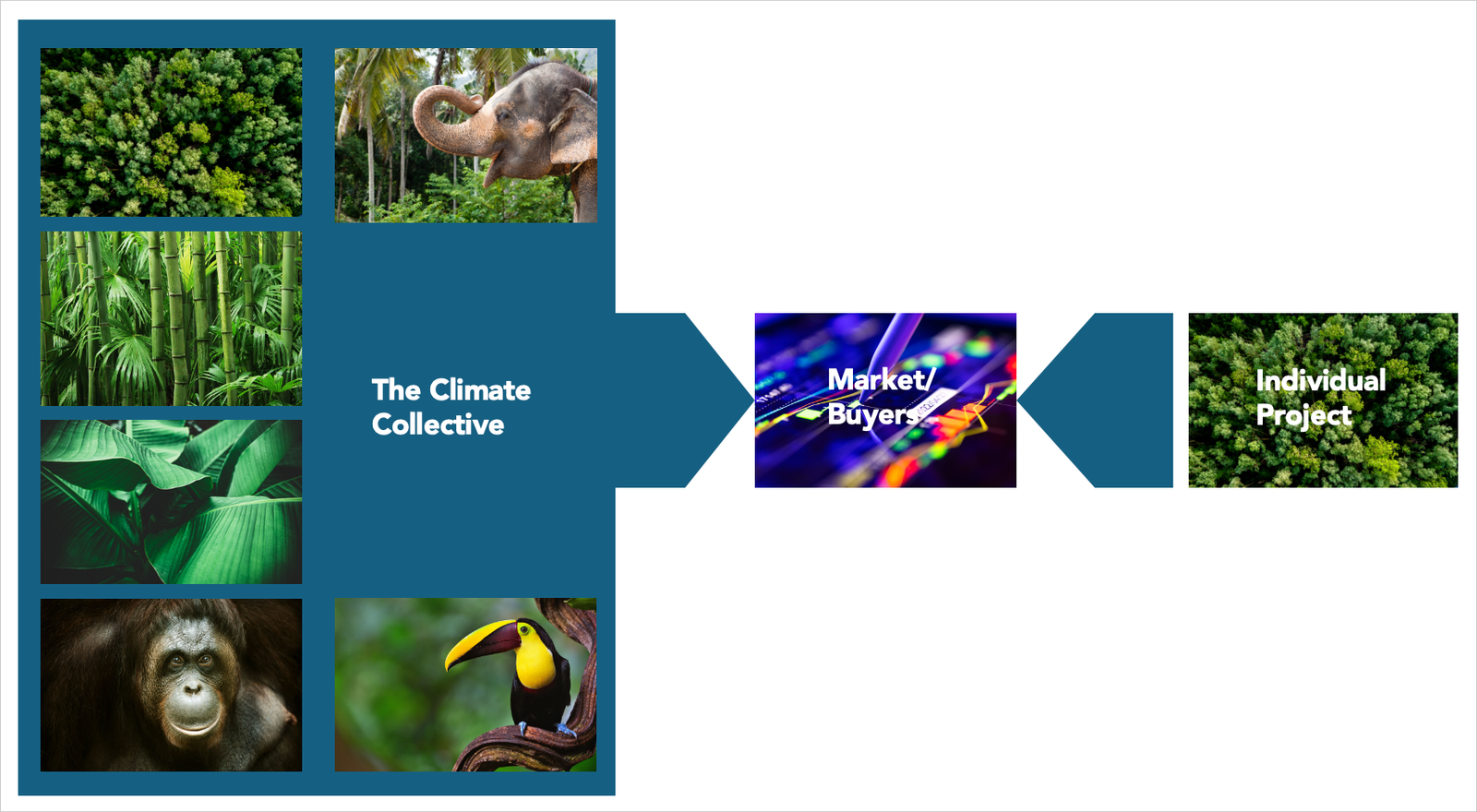
The Climate Collective takes a portfolio of projects to market; an individual project reaches the same buyers alone
The Collective reaches the market with a portfolio drawn from many sites and project types. An individual project reaches the same buyers on its own — one story, one set of risks, one delivery record.
Why a portfolio
three claims, one portfolio
01

Security of delivery

Selling carbon assets through a diversified portfolio gives buyers something a single project never can. By spreading exposure across multiple project types — REDD+, blue carbon, clean cookstoves, renewable energy — and geographies, a portfolio reduces the chance that any one regulatory change, methodology update, natural event, or community issue will materially affect overall delivery.

Performance outliers are smoothed out by stronger projects, so volume and quality of credits are more predictable year-on-year. For buyers with public climate commitments, this diversification supports long-term offtake needs, stabilizes the cost of abatement over time, and reduces headline risk associated with underperforming or controversial projects.

02

Integrity and credibility

Integrity is not asserted, it is bought and evidenced. Every project admitted to the Collective is assessed before issuance by an internationally reputable independent third party — a carbon project assessor or rating agency — and the result travels with the credit rather than sitting in a file.

Pre-issuance assessment matters because the failures that damage buyers are rarely visible in the credit itself. Over-crediting from an inflated baseline, weak additionality, consent obtained without genuine consultation, permanence promised without the tenure to deliver it: each is a property of how the project was designed, and each is far cheaper to catch before units exist than to explain after a buyer has retired them against a public commitment.

Running that screen once, at the portfolio level, also spreads a cost no single developer can carry efficiently. The Collective admits on assessed quality and applies the same rating, safeguard and integrity standard to every member — which is what lets a buyer treat any unit from the portfolio as equivalent, and what protects the members from being repriced by someone else’s failure.

03

Complete story

A portfolio also upgrades the narrative value of carbon credits. Instead of a single story in a single place, buyers can show how their contribution supports a mosaic of climate and sustainability outcomes: forest protection and biodiversity in one country, women's health and clean energy access in another, coastal resilience and fisheries in a third.

This makes internal and external storytelling far more engaging — for employees, investors, and customers — while still sitting on a robust technical foundation of diverse methodologies, vintages, standards, and co-benefits. A portfolio structure turns carbon procurement from a narrow transactional purchase into a curated, de-risked climate impact strategy.

How the Collective is structured
supply, assurance, and two product lines
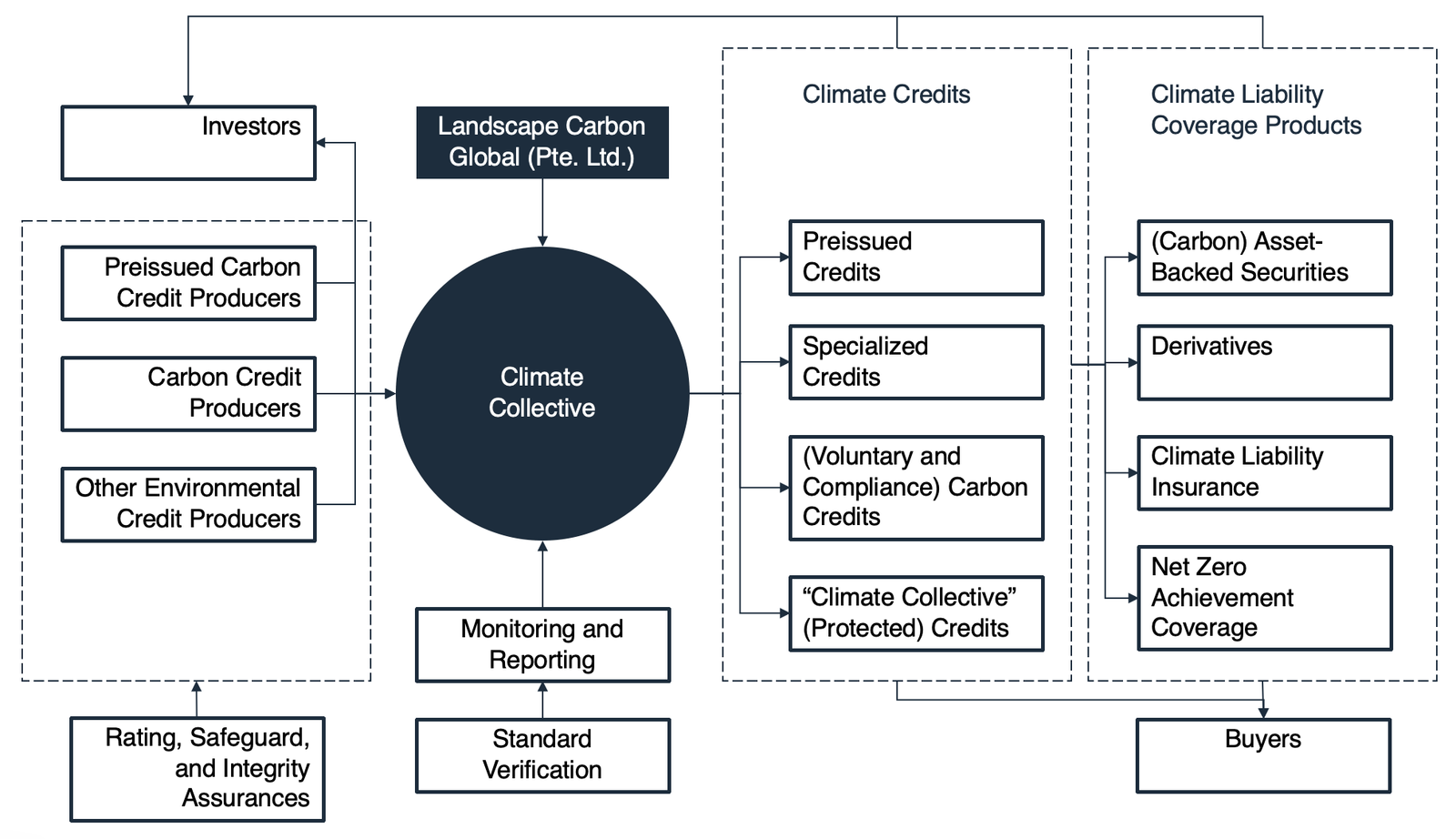
Producers and investors feed into the Climate Collective, which is convened by Landscape Carbon Global and underpinned by standard verification and monitoring, with rating, safeguard and integrity assurances applied to each project and to the portfolio; the return line from both product columns runs back to investors as well as forward to buyers; it issues climate credits and climate liability coverage products, both reaching a common pool of buyers
Credit producers and investors enter on the left; the Collective aggregates their output under common monitoring, reporting and standard verification, with rating, safeguard and integrity assurances applied to each project and to the portfolio. Two product columns leave on the right — climate credits, and climate liability coverage products — and the return line runs back to both buyers and investors.

Reading the diagram

Four flows meet at the centre. Supply enters from the left, assurance from below, sponsorship from above, and two product lines leave to the right — converging again on a single pool of buyers.

Note what the dashed outlines enclose. On the left they bracket the three producer groups, every one of whose projects must pass rating, safeguard and integrity assurance before anything it holds can enter. On the right they bracket the two product families, which are distinct instruments but a single market. The Collective itself is not a project and not a broker. It is the point at which a set of independently produced, independently verified environmental assets becomes a single portfolio that can be sold, priced and insured as one thing.

What enters
Investors

Capital ahead of issuance — the pre-financing that lets a project reach validation without selling its first credits at a discount. The return line runs back to them from both product columns.

Preissued carbon credit producers

Projects validated but not yet issued. Their future credits can be committed to the portfolio before the registry catches up.

Carbon credit producers

Issued, verified units from projects already operating — the portfolio’s working stock.

Other environmental credit producers

Water, biodiversity and other ecosystem service units, so the portfolio is not confined to carbon alone.

What underpins it
Landscape Carbon Global, Pte. Ltd.

The convenor. It establishes the Collective and sets the terms of membership; it does not own the members’ assets.

Standard verification

Independent, pre-issuance assessment against an internationally recognised standard. Nothing enters the portfolio without it.

Monitoring and reporting

Continuous performance data after issuance. This is what allows delivery risk to be priced rather than guessed at.

Rating, safeguard and integrity assurances

Applied twice over — to every individual project and to the portfolio it joins: an integrity rating from a recognised agency, social and environmental safeguards, and the assurance that a credit is additional, permanent and counted once.

What leaves
Climate credits

Four instruments: preissued credit, specialized credit, voluntary and compliance carbon credits, and the protected “Climate Collective” credit that carries the portfolio guarantee.

Climate liability coverage products

Carbon asset-backed securities, derivatives, climate liability insurance, and net zero achievement coverage.

Why two lines

The same verified portfolio serves both a buyer acquiring reductions and a buyer hedging an exposure. One is an asset sale, the other risk transfer — and both reach the same buyers, who can take a credit, the cover that protects it, or both together.

What an investor gets back

Investment into the Collective is not only a financial position. The return line in the diagram runs from both product columns back to investors, and it can be settled in cash or in kind.

Capital enters ahead of issuance, which is where it is scarcest and most useful. A project between validation and its first verified credits has costs and no revenue, and without pre-financing it typically sells forward at a steep discount to whoever will carry that gap. Investors who close it take the ordinary financial return on that risk — the spread between what a pre-issuance commitment costs and what a verified, portfolio-backed credit fetches.

The second return is the one the diagram makes explicit. An investor may take settlement in the Collective's own output rather than in cash: climate credits, including the protected credit carrying the portfolio guarantee, or climate liability coverage products — asset-backed securities, derivatives, liability insurance, net zero achievement coverage. For an investor that is itself an emitter, or that holds carbon exposure in a portfolio of other assets, this converts a financial allocation into compliance or hedging value it would otherwise have to buy at market.

That option changes who can sensibly invest. A fund seeking yield and a corporate seeking reductions are usually in different markets, buying different instruments on different timetables. Here they can take the same position and draw different value from it, which widens the capital available to the producers upstream and narrows the discount those producers have to accept.

Why the structure matters

A single project can sell a credit. It cannot sell a guarantee.

The assurance layer beneath the circle is what makes the difference. Because every member is assessed before issuance and monitored after it, the Collective knows the distribution of delivery risk across the whole portfolio — not just the promise of each project. That knowledge is the raw material for the second column of products: you cannot write insurance, structure a security, or price a derivative against assets whose performance you cannot characterise.

Rating, safeguard and integrity assurance is the newest and the most consequential part of that layer. Carbon markets have been damaged less by projects that failed than by projects nobody could independently grade — inflated baselines, reversals that went unreported, communities whose consent was assumed. An independent rating gives a numerical, comparable view of quality across a portfolio; safeguards test the social and environmental conditions under which the reduction was produced; integrity assurance tests the three claims that make a credit a credit at all — that it is additional, that it is permanent or insured against reversal, and that it is counted once. The assurance runs at both levels. Each project is rated, safeguarded and tested for integrity in its own right, so nothing enters on the strength of its own account of itself; the portfolio is then assessed again as a whole, because a set of individually sound projects can still carry correlated risk — the same jurisdiction, the same methodology, the same fire season. Passing at one level does not substitute for the other.

It also changes what a buyer is offered. A protected Collective credit is backed by the portfolio rather than by one site, so underperformance at one project is absorbed by the others instead of landing on the buyer who happened to choose it. For a company with a public commitment and a board to answer to, that is a materially different product from a credit bought project by project — and it is the reason the diagram has a circle at its centre rather than a list.

Membership

Joining the Collective

Prospective members need to have their projects assessed by an internationally reputable carbon project assessor or rating agency to hold the highest quality standard.

Reference

Indonesia Carbon Market Regulations

A working register of the instruments that govern carbon pricing and trading — the two laws, the presidential umbrella, the sectoral ministerial regulations, the exchange rules, and Article 6 — with what each requires and what it means for a project developer. Current to Perpres 110/2025, which replaced the 2021 framework and reopened international sales.

Open the register →