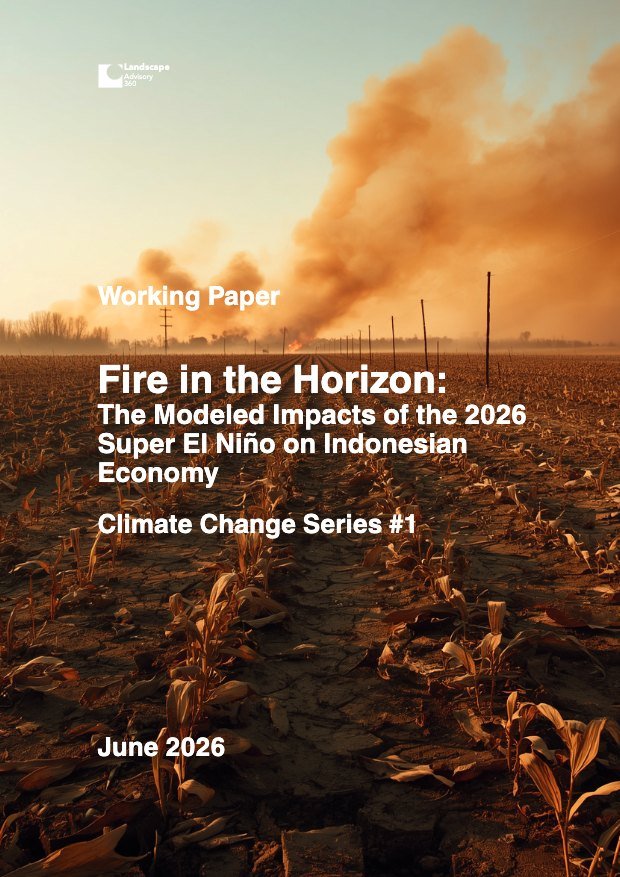
Fire in the Horizon
The modeled impacts of the 2026 super El Niño on the Indonesian economy — the indirect wave costs more than the scorched fields.
The paper traces the shock from Pacific sea-surface temperature anomalies through Indonesian rainfall to harvests, fire, haze, and the public budget. Its central argument is that the visible damage — burnt land, lost crops, closed airports and schools — is the smaller half of the bill. The larger half arrives indirectly, through staple food prices, health costs, lost labor productivity, disrupted logistics and the fiscal response, and it lands on households that had no exposure to the fire itself.
The analysis runs on ENSOID26-V2, a system dynamics model built for this work and published alongside the paper, so the assumptions and the transmission channels can be inspected and re-run rather than taken on trust. The policy implication is about sequencing: the interventions that reduce the total cost most are the ones taken before the season peaks — peatland rewetting and water management, early-warning and suppression capacity, and staple food buffers — not the compensation paid afterwards.
Retiring Cirebon-1 would ripple upstream to the coal-producing provinces — and international finance alone will not cover the socio-economic cost.
The economic burden on Indonesia of the Middle-East conflict and the closure of the Strait of Hormuz. Includes the ESHOCKID26 model.
A scoping study on using transition credits to shift captive, off-grid coal-fired power plants to renewables.
Strengthening traceability, smallholder inclusion, and landscape monitoring systems — with cases from Indonesia and Malaysia, nested carbon accounting, and the financing architecture to pay for it. Editorial team: Agus P. Sari, Niken Pradonawati, Putri A. Agustina, Bernardinus Steni.
Rapid assessment of possible long-term ecological and socio-economic recovery in flood-affected areas in Aceh — a jurisdictional landscape approach linking watershed restoration to reconstruction finance.
Fundamental reform for a sustainable, affordable, equitable, and low-carbon power market in Indonesia.
Increasing resilience through nature-based recovery in Aceh, North Sumatera, and West Sumatera.
Tripling renewables and doubling the pace of efficiency improvement by 2030 in Indonesia. Tripling is already in the baseline — the binding problem is coal capacity doubling alongside it. With the Center for Global Sustainability, University of Maryland.
Siak, Riau, Jurisdictional Investment Outlook 2022 — investment opportunities across the district under the Green Siak roadmap, and the blended financing structure behind them.
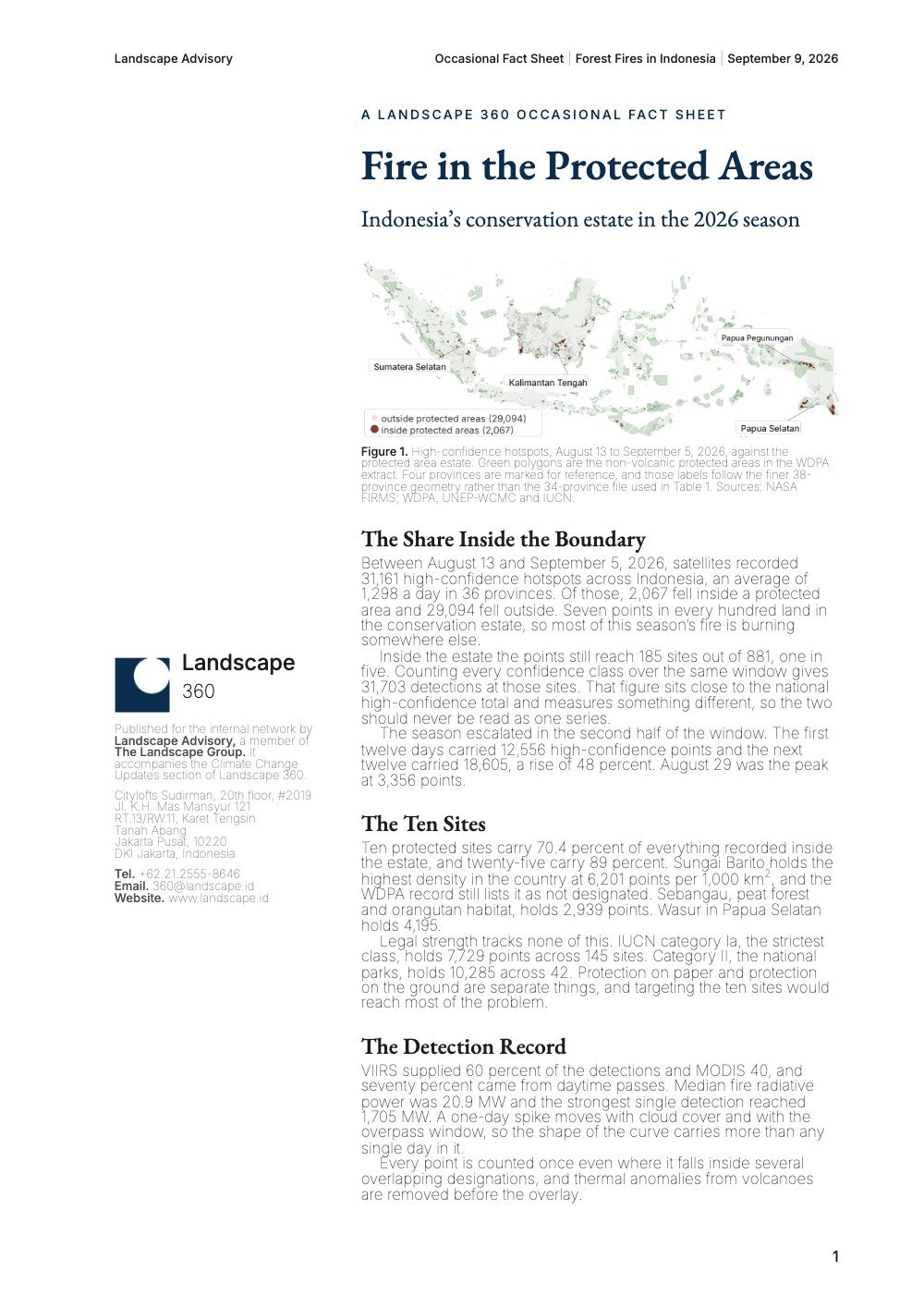
Fire in the Protected Areas
Indonesia's conservation estate in the 2026 season: 2,067 high-confidence hotspots inside the estate, ten sites carrying 70 percent of them, and legal protection tracking none of it.
Indonesia, the health price of the 2026 fires.
Indonesia, January 1 to August 26.
Kalimantan, August 13 to 22.
The 2026 fire season, week of August 13 to 20.
The 1H26 Outlook: the fire season ahead and the fuel-price exposure behind it.
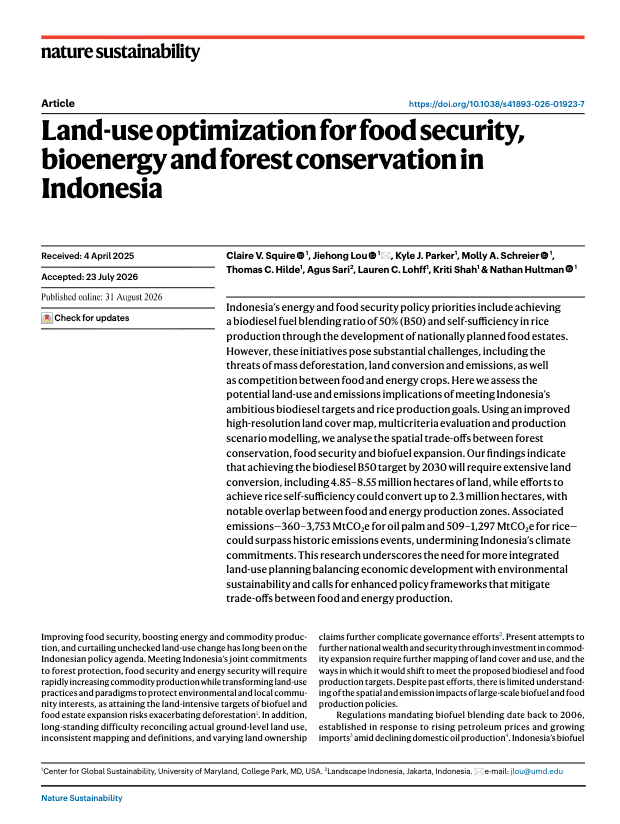
Land-use optimization for food security, bioenergy and forest conservation in Indonesia
Indonesia is pursuing a 50 percent biodiesel blend and rice self-sufficiency at the same time. This paper maps what both targets would cost in land, and where the two collide. Claire V. Squire, Jiehong Lou, Kyle J. Parker, Molly A. Schreier, Thomas Hertel and others.
The Diplomat.
Climate Policy, vol. 24 no. 1. Erik Haites, Paolo Bertoldi, Michael König, Christopher Bataille, Felix Creutzig, Dipak Dasgupta, Stéphane de la Rue du Can, Smail Khennas, Yong-Gun Kim, Lars J. Nilsson, Joyashree Roy and Agus Sari. On the emissions-intensive, trade-exposed sectors — aluminium, cement, chemicals, iron and steel, lime, pulp and paper, petroleum refining — where mitigation costs are highest.
Chapter 12 in Climate Change Research, Policy and Actions in Indonesia: Science, Adaptation and Mitigation (Springer Climate), eds. Riyanti Djalante, Joni Jupesta and Edvin Aldrian. Agus P. Sari, Alue Dohong and Budi Wardhana.
Landscape in the News → collects press coverage. Strategic Outside Publication → carries the assessments our work is measured against.