What the series is
Two publication lines run under Landscape 360, on different clocks and for different purposes.
The Outlook appears twice a year. It takes the half-year as a whole and asks what changed in the conditions the Group works under — energy prices and supply, the climate signal, the state of the carbon market, the fiscal position — and what those changes imply for the next six months. Each edition is dated by half-year and numbered accordingly.
The Occasional Fact Sheets appear when an event warrants them. They are short, tightly scoped, and built on a named dataset, so a reader can check the figures rather than take them on trust. The 2026 fire season accounts for the current run.
Both are published without charge, and both state their data sources and assumptions in the document.
What it covers
The series follows the same subject matter as the Group’s advisory work, released in numbered series by theme.
Energy transition: power market reform, coal retirement and transition credits, distributed renewables, and the socio-economic implications of the shift at sub-national level. Climate crisis and decarbonization: the modeled economic cost of climate events, carbon pricing, net zero pathways, and Indonesia’s contributions under the Paris Agreement.
Nature-based and ecosystem services: deforestation and commodity value chains, forest finance, jurisdictional sourcing, peat and coastal restoration, and nature-based recovery after disaster. Geopolitics and macroeconomics where they bear directly on Indonesia’s energy and climate position.
Who it is for
The audience is anyone who has to act on these issues and is not served by either a press release or a consultancy invoice.
Government agencies and their advisors, who need the numbers behind a policy option before committing to it. Companies and investors assessing exposure and opportunity. Journalists covering energy and land use, who need a source that will show its working. Researchers, students, and civil society organizations building on the evidence base.
All output is published without charge. Where a piece was produced under a commissioned assignment, the commissioner is named and the release is agreed with them.
Carbon Markets Move From Writing Rules to Running Them
The Article 6 rulebook is finished. Antalya decides how to pay for the system and how to check its quality.
Under Article 6 countries trade emission cuts with each other (6.2), earn credits from a UN mechanism (6.4) or cooperate without trading (6.8). The rules were completed in Baku in 2024 and a full review is due in 2028. Six items are on the table in Antalya: funding for Article 6.2, whose registry and expert reviews face a shortfall of about $8 million to $9 million; the quality of country deals, where UN reviewers found integrity issues in every one of the 13 initial reports reviewed so far; the Paris Agreement Crediting Mechanism, which issued its first credits in February 2026; the move of more than 300 CDM activities from about 80 countries; non-market cooperation; and reporting.
The second biennial transparency reports, due by December 31, 2026, will record the first large volumes of authorized credits and give the 2028 review its evidence. Indonesia reported deals to sell 2.75 million credits at COP30 and counts carbon markets toward an investment need of about $472.6 billion; clear reporting and a strong expert review will raise the price buyers pay for its credits.
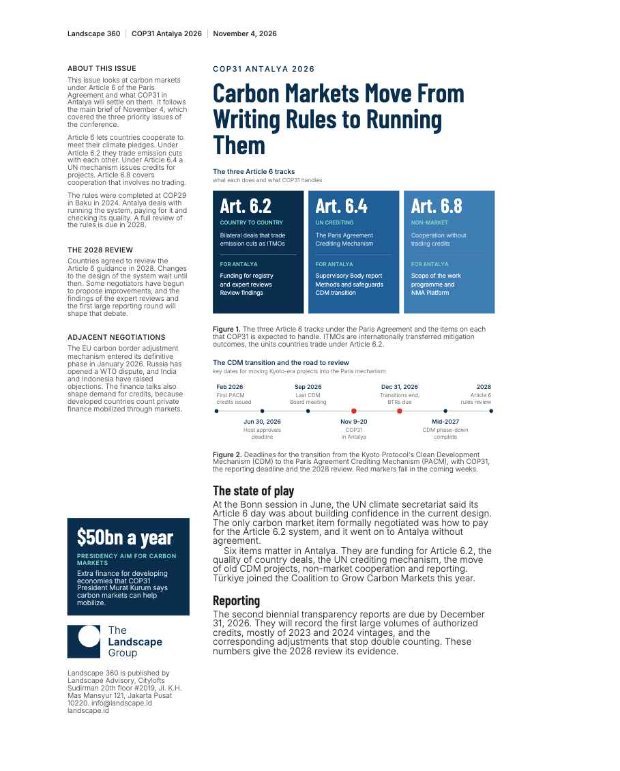
Landscape 360, 4 November 2026: the three unfinished deals in Antalya, a 16 Gt CO2e emissions gap in 2035, and what the outcome means for Indonesia’s $472.6 billion transition.
Fire reached 36 of 51 national park units in 2026, about 120,000 ha burned; Tanjung Puting and Wasur lead, and state forest outside concessions holds about 45 percent of all burning.
Papua’s 2026 fires beside the rest of Indonesia: 313,777 ha of burn scar to September, 28 percent of the national total, and why hotspot counts still rank Kalimantan first.
The nine LTKL districts and fire: 5.3 percent of Indonesia’s land, 0.9 percent of the 2026 burned area, and Siak’s 99.5 percent fall in burned area from 2015 to 2023.
Fire inside 29 of 39 Verra carbon projects released an estimated 16.7 Mt CO2e in 2026, 45 percent of a year of their expected credits; buffers cover about a quarter of the loss.
The 2026 El Niño near its peak: a record weekly Niño 3.4 of 3.3°C, fires that may run into November, and a 13 percent CPC chance of La Nina by mid-2027.
Agriculture emitted 135.6 Mt CO2e in 2022. Farm practices and removals could deliver about ten times the Second NDC’s sector target, and Permentan 18/2026 now gives rice, livestock, estate crops and biochar a route to carbon credits.
Hotspots, burned area and fire emissions since January: 1,224,060 hotspots to October 17 and 673 Mt CO2e to October 15, two thirds from peat and 74 percent of 2015 at the same date.
Indonesia’s conservation estate in the 2026 season: 2,067 high-confidence hotspots inside the estate, ten sites carrying 70 percent of them, and legal protection tracking none of it.
The 1H26 Outlook: an energy shock and a record-hot planet converge on the same six months.
Indonesia, the health price of the 2026 fires.
Indonesia, January 1 to August 26.
Kalimantan, August 13 to 22.
The 2026 fire season, week of August 13 to 20.
The weekly read sits alongside the dated series
Where the Outlook takes six months and a fact sheet takes one event, the Weekly 360 screens the day's coverage and carries three highlights.