An economic event, not only an environmental one
Warming is already changing what land produces, what infrastructure costs to keep running, and what governments spend after each disaster.
Drought and fire cut harvests and close airports; floods take out roads, irrigation and housing; heat lowers labor productivity and raises power demand at the same time. Each event travels beyond the place it strikes — through supply chains, insurance, public budgets and the cost of capital. For a tropical archipelago with a large agricultural workforce and long coastlines, exposure is structural rather than occasional.
Two kinds of risk follow. Physical risk is the damage itself, acute and chronic. Transition risk is the repricing that comes with the response: carbon costs, disclosure requirements, border measures, and assets that lose value before the end of their design life.
What the impacts look like
The damage arrives through a small number of repeating channels, and each one has a price.
Agriculture takes the first hit: shifted rainfall and longer dry spells lower yields of rice, palm and coffee, while fire in drained peat destroys standing crops and closes airports and schools for weeks. Water follows — reservoirs and irrigation systems designed for a former rainfall pattern now swing between shortage and flood, and cities on subsiding coasts face saline intrusion into their supply.
Infrastructure and public budgets absorb the rest. Floods and landslides take out roads, bridges and housing, and reconstruction competes with planned development spending. Heat lowers outdoor labor productivity and raises electricity demand at the same time as it constrains generation. Health costs rise with haze and heat exposure. Coastal communities and small-island districts carry the sharpest concentration of these effects, and they are the least able to finance recovery.
The international framework
Two instruments set the terms under which every country now acts: the UNFCCC and the Paris Agreement.
The UN Framework Convention on Climate Change, agreed in 1992, established the objective of stabilizing greenhouse gas concentrations at a level that avoids dangerous interference with the climate system, and the principle that countries act according to common but differentiated responsibilities and respective capabilities. It created the machinery — annual conferences of the parties, national inventories, reporting — but not binding reduction levels.
The Paris Agreement, adopted in 2015, supplied the goal and the mechanism. It holds warming well below 2°C above pre-industrial levels and pursues 1.5°C, and it works from the bottom up: each country submits a Nationally Determined Contribution, revisits it every five years, and is expected to raise ambition with each cycle. A global stocktake measures collective progress against the temperature goal, and the reporting framework makes each country’s performance comparable.
Article 6 of the Agreement allows countries to cooperate on mitigation and to transfer emission reduction outcomes between them, provided the accounting avoids double counting. That provision is the legal basis on which national carbon markets, crediting mechanisms and the current generation of transaction rules are being built — and the reason carbon has become a tradable asset with a regulatory history rather than a voluntary gesture.
Why ambition has to rise
The gap between current pledges and the Paris temperature goal is a quantity of emissions, and it has a date attached to it.
Holding 1.5°C requires deep cuts this decade, not only mid-century targets. Every year of delay narrows the remaining budget, raises the rate of reduction needed later, and increases reliance on removals that are neither cheap nor proven at scale. Delay also builds new long-lived, high-emitting assets whose retirement then has to be financed.
For Indonesia the two largest levers are the power system and land use. Coal dominates generation and captive industrial power; deforestation, peat degradation and fire dominate land-based emissions. Both are also where the co-benefits sit: cleaner air, more resilient water supply, and rural income that does not depend on clearing.
Net zero is an accounting identity, not a slogan
Net zero means residual emissions are balanced by permanent removals. Temperatures stabilize only when that balance is reached, which is why the target date matters as much as the target itself. Getting there requires reduction first and removals last: efficiency and electrification, clean generation, industrial process change, halted deforestation and restored ecosystems, and only then removals for what cannot be abated.
Each of those steps is a financing question. The Landscape Group's work sits at that junction: quantifying the risk, structuring the finance, and building the carbon assets and markets that let reductions be paid for — bridging decarbonization and sustainable landscape management with green financing.
1.5°C will be crossed. What happens after is still a choice.
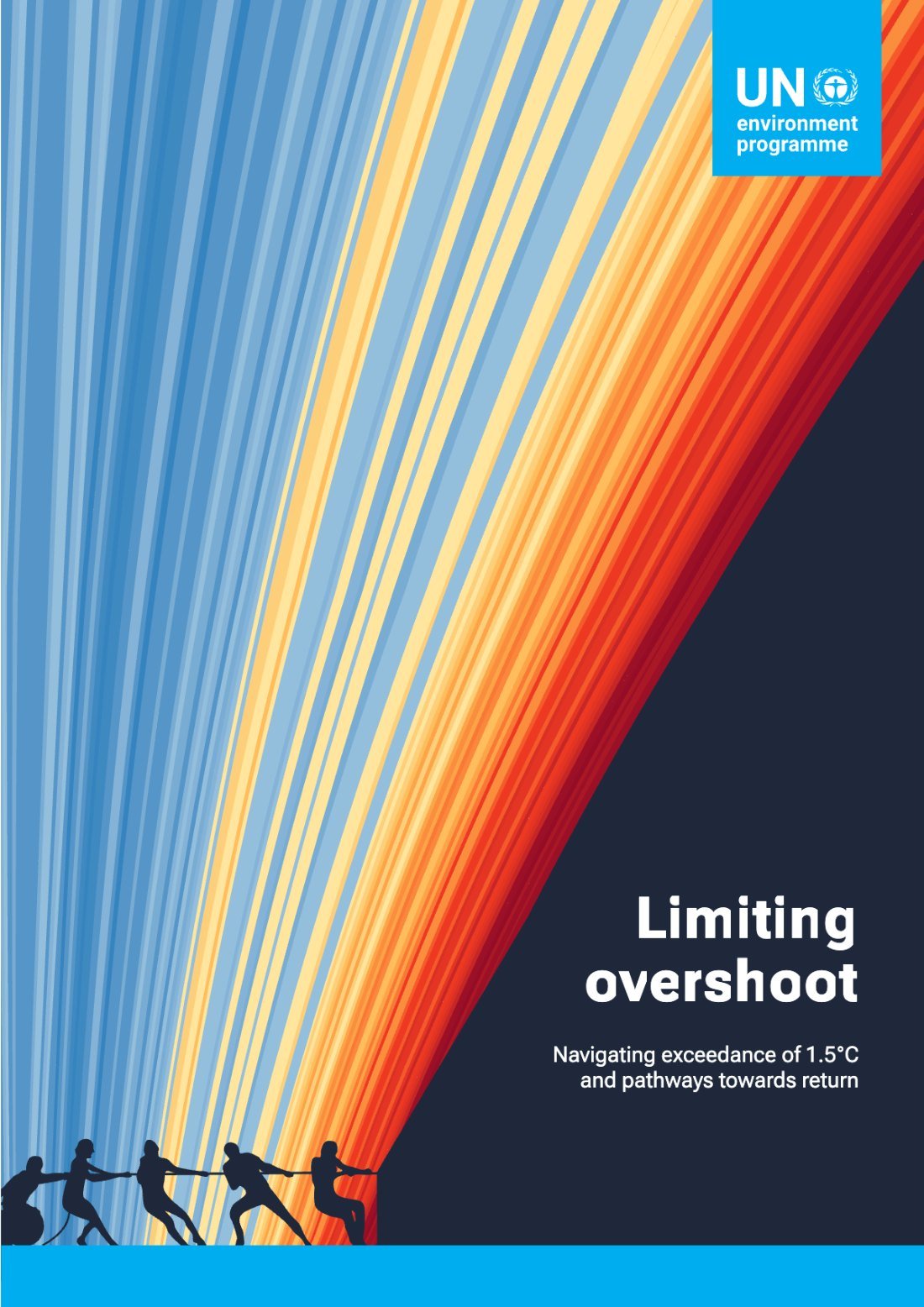
UNEP's 2026 assessment concludes that emission cuts have not been fast enough to avoid crossing 1.5°C above pre-industrial levels within the next few years.
Even on an optimistic reading of current pledges — every national climate plan fully implemented and every additional net-zero target met — expected peak warming is 1.8°C. The report is explicit that exceedance is neither safe nor acceptable: there are no benign scenarios above 1.5°C, and the risks include faster sea-level rise, coral reef collapse, more extreme heat and fire, and a higher chance of irreversible tipping points.
The goal is not rescinded — it is approached from above. The route is an overshoot, peak and decline pathway: hold peak warming as low as possible, then bring temperature back below 1.5°C by the end of the century while adapting to the impacts that arrive in the meantime. Every fraction of a degree avoided and every year by which overshoot is shortened reduces losses and improves the odds that warming can be brought down at all.
The levers are named: immediate deep cuts to CO₂, methane and other short-lived climate pollutants; net zero treated as a milestone on a longer path to net-negative emissions; carbon dioxide removal at scale, with its limits and governance requirements stated; and transformational adaptation delivered alongside mitigation rather than after it. Equity runs through all of it — those with greater historical responsibility acting fastest, and those who contributed least not left to carry the largest burden.
The agreement itself, its temperature goal, and the five-year ambition cycle that governs every national commitment.
Every Nationally Determined Contribution as submitted, including Indonesia’s — the primary source for what has actually been pledged.
The rules for transferring mitigation outcomes between countries — the legal basis for national carbon markets and crediting.
The scientific baseline: remaining carbon budgets, the mitigation pathways consistent with 1.5°C, and regional impacts for Southeast Asia.
Navigating exceedance of 1.5°C and pathways towards return — the assessment summarized above.
The annual measure of the distance between current pledges and the Paris temperature goal, and what closing it would require.
The comprehensive investment and policy plan for Indonesia’s power sector transition, and its progress reporting.
Generation mix, capacity additions and demand data — the numbers behind any power market or coal retirement argument.
Managing a whole area as one system, and the institution that has to govern it through planning, implementation and monitoring.
Three national commitments — rice self-sufficiency, B50, and FOLU Net Sink 2030 — competing for the same land.
Recovery that rebuilds the catchment as well as the settlement, financed as flood infrastructure.
Where the national emissions pathway and FOLU accounting work is done, including the second NDC contribution.
Power market reform, carbon pricing, coal retirement and transition finance for Indonesia’s electricity system.
Assessments published elsewhere that set the reference numbers our work is measured against.
Our own analysis — working papers, rapid assessments and peer-reviewed articles — built on the sources above.