The outcome
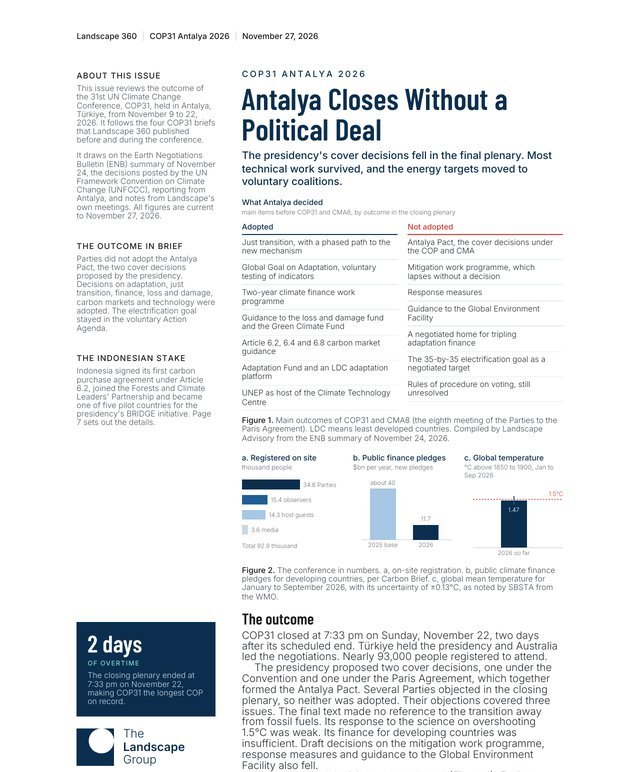
COP31 closed at 7:33 pm on Sunday, November 22, two days after its scheduled end, making it the longest COP on record. Türkiye held the presidency and Australia led the negotiations. Nearly 93,000 people registered to attend.
The presidency proposed two cover decisions, one under the Convention and one under the Paris Agreement, which together formed the Antalya Pact. Several Parties objected in the closing plenary, so neither was adopted. Their objections covered three issues: the final text made no reference to the transition away from fossil fuels, its response to the science on overshooting 1.5°C was weak, and its finance for developing countries was insufficient. Draft decisions on the mitigation work programme, response measures and guidance to the Global Environment Facility also fell.
Many technical decisions were adopted: a phased path to the just transition mechanism, voluntary testing of the adaptation indicators, a two-year climate finance work programme, guidance to the loss and damage fund and the Green Climate Fund, Article 6.2, 6.4 and 6.8 guidance, an LDC adaptation platform, and UNEP as host of the Climate Technology Centre. Earlier commitments, including the 2023 Dubai call to transition away from fossil fuels, remain in force.
The Antalya Pact falls over fossil fuels
The final draft dropped every reference to fossil fuels, and a large group of Parties refused to adopt it.
The presidency’s early drafts paired a global electrification goal with the Dubai goals of tripling renewable capacity and doubling energy efficiency. Some producer countries could not accept even that. By the final draft, every reference to the energy transition and to fossil fuels had been removed, while language on carbon capture, utilization and storage remained. The EU, Panama, Vanuatu, Belize, the Marshall Islands and others objected; the Arab Group, Pakistan, Iran, Syria and Venezuela supported adoption, and the African Group voiced concerns but did not block.
The loss of the mitigation work programme matters as much as the pact. Parties agreed in 2022 that it would run until this session, which was to decide on its future. Most wanted it to continue but disagreed on the end date, and no decision was adopted, so its future is unclear.
Finance remains the main dividing line
New public finance pledges fell sharply, and the loss and damage fund holds a fraction of what countries have requested.
The one clear outcome is a climate finance work programme for 2027 and 2028, with submissions, workshops and virtual dialogues, though Parties still disagree on its scope. Developing countries wanted a home for the Belém call to triple adaptation finance by 2035; with the pact rejected, it has none.
The Fund for responding to Loss and Damage has received 176 funding requests from 119 developing countries, worth about $2.8bn, against an allocation of $342m. Carbon Brief finds that new public pledges average about $11.7bn a year, down from about $40bn, against the goal of at least $300bn a year by 2035.
Adaptation and just transition advance in small steps
Parties kept both workstreams moving and set the dates for the next decisions, most of them at COP32 in Addis Ababa.
Parties agreed to test the 59 Belém adaptation indicators voluntarily, report their experience for a synthesis at CMA9, hold a virtual technical dialogue by August 2027, and set up a technical task force of 36 experts. The COP and CMA also set up an LDC platform for implementing national adaptation plans.
On the just transition mechanism agreed in Belém, Parties chose a phased approach: the subsidiary bodies will develop its functions and operating arrangements at SB66 in June 2027, for adoption at CMA9, with views due in March 2027.
Carbon markets and forest finance move ahead
The Article 6 decisions passed, Indonesia signed its first purchase agreement, and the forest facility closed in on its launch target.
Under Article 6.2 the CMA asked the secretariat to report on the code of practice, finish the guidance for technical expert reviews and give priority to the central accounting platform, while noting a continuing shortfall in resources for this work. The Article 6.4 Supervisory Body was asked to explain how it ranks work on methodologies and to consider a time limit for host countries to authorize credits.
On November 11, witnessed by the environment ministers of Indonesia and Norway, PLN and the Global Green Growth Institute signed an agreement under which Norway will buy up to 12 million tons of CO2e from PLN’s solar projects by 2038, at $20 to $40 a ton: Indonesia’s first Article 6.2 agreement. Indonesia reaffirmed its $1bn commitment to the Tropical Forest Forever Facility and, on November 13, joined the Forests and Climate Leaders’ Partnership.
The Action Agenda carries the energy targets
With the cover decisions gone, electrification, fossil fuel roadmaps and project finance move forward through voluntary coalitions.
Türkiye’s 35-by-35 pledge would raise electricity from about 23 percent of global final energy today to 35 percent by 2035. Countries endorsed it at the Leaders’ Summit on November 11, but it stayed out of the negotiated text. The coalition on transitioning away from fossil fuels formed at Santa Marta plans its second conference in 2027.
BRIDGE, the presidency’s Climate Implementation Bridge run with UNDP, is not a new fund: it aims to help countries build finance-ready portfolios. Indonesia is one of its five pilot countries, with Ethiopia, Fiji, Pakistan and Uzbekistan.
Indonesia seeks deals and partners
The delegation pursued carbon finance, forest partnerships and project finance, while its coal plans drew questions at home.
Hashim Djojohadikusumo, the President’s special envoy for climate and energy, led the delegation under the theme “Delivering Climate Solutions at Scale.” The Second NDC needs about $472.6bn to meet its mitigation targets. At the carbon sessions, Eddy Soeparno described a power plan that adds 62 GW, of which 52.5 GW is renewable with storage.
Carbon was the busiest part of Indonesia’s program. The pavilion hosted buyer and seller meetings for 14 projects and launched the Indonesia Climate and Carbon Partnership, and on November 10 the Indonesian Climate and Growth Dialogue opened its High Integrity Principles for Indonesia to international comment. Analysts quoted by The Jakarta Post noted that the stalled plan to retire coal plants early went unmentioned.
Landscape’s work and the road to Addis Ababa
Landscape published four briefs and joined sessions on energy security, carbon integrity and nature risk. The next decisions fall in 2027.
Agus P. Sari spoke at a session on energy transition under energy security concerns, met ICGD and the Steering Committee for the Economic Value of Carbon (Komrah) on how UNDP can support their work, and presented LNRA, Landscape’s nature risk assessment, at a media briefing by Harita Nickel.