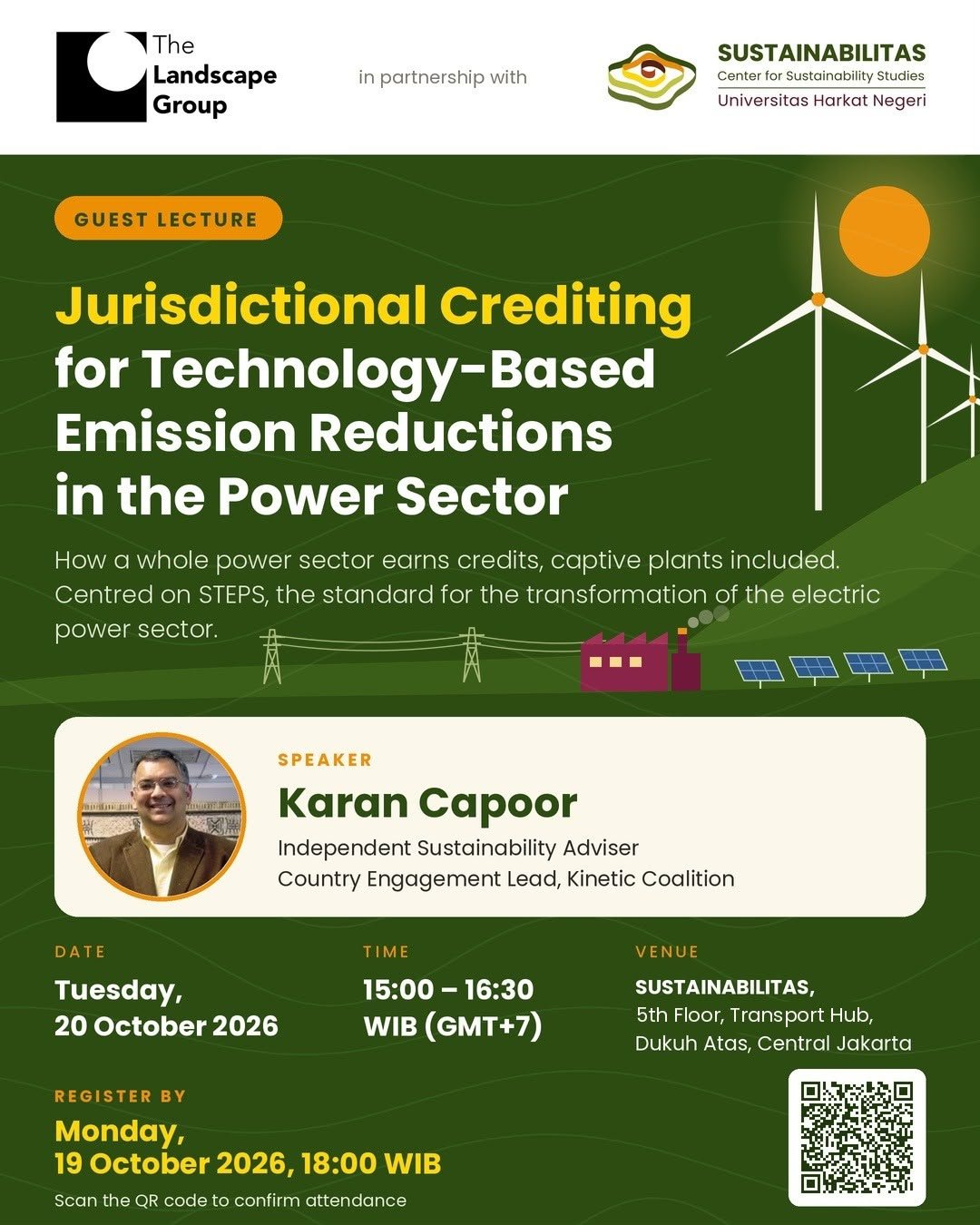
Registration closes Monday, 19 October 2026, at 18:00 WIB.
Jl. Ps. Blora No. 24 Blok F1, Dukuh Atas
Menteng, Central Jakarta 10310
Map →
About the lecture
Indonesia’s coal fleet is still growing, and much of the growth is captive coal capacity built to power smelters and industrial parks. Coal plants are built to run for decades, so every new unit postpones the reductions the power sector needs this decade. Retiring plants early is hard to negotiate one by one: owners and coal producers have little reason to close early, public support for early retirement is limited, and captive plants fall outside most project-based transition credit methodologies.
Jurisdictional crediting takes a different route. Already established for forests, for example jurisdictional REDD+ under ART, it has now been designed for technology-based reductions in electricity. STEPS, developed by Environmental Resources Trust and ACR, both part of Winrock International, with the Energy Transition Accelerator, credits a country’s whole power sector for lowering its emissions rate faster than a declining, country-specific performance standard.
Because results are measured for the national sector, crediting does not depend on any single owner’s decision to retire a plant. Credits go to the national government or its designee, which can combine renewable deployment, grid investment, efficiency and coal retirement to bring the emissions rate down. The boundary covers all generation in the country, including captive plants of 1 MW or more, and each new unabated coal plant is deducted from the credits by its total emissions. ICAO has found STEPS units consistent with ACR’s CORSIA approval, the first jurisdictional credits beyond REDD+ to be found eligible. Version 1.0 was published as a draft for public comment in April 2026.
The lecture explains how STEPS works, compares it with project-based transition credit methodologies such as Verra VM0052 and the Gold Standard JUST methodologies, and discusses what Indonesia would need in place to take part.
What the lecture covers
Speaker
Karan advises companies, governments, development finance institutions, philanthropies and NGOs on climate finance, carbon markets and mobilizing green investment. At Kinetic Coalition, an independent non-profit initiative, he leads country engagement for channeling corporate investment into clean energy systems in emerging economies through sector-wide approaches using energy transition credits. The coalition’s published pilots are in the Dominican Republic and Chile.
Program
Questions
Michael Kurniawan, Landscape Indonesia: michael.kurniawan@landscape.id · +44 773 318 4473
Tania, Universitas Harkat Negeri: tania@harkatnegeri.ac.id · +62 812-3025-7273